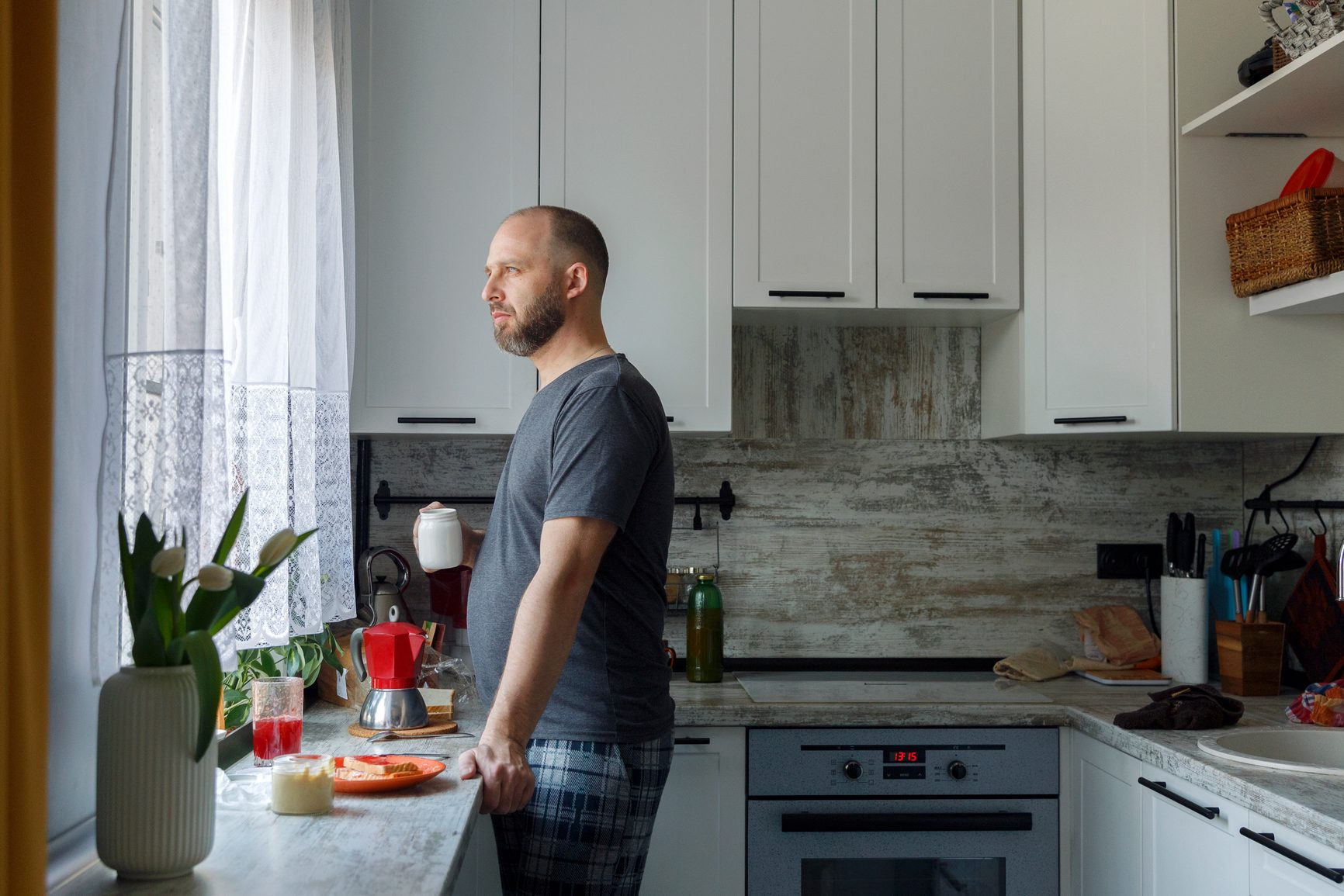
If this is you
You get through the day without much trouble. Then you lie down, and the burning climbs into your chest. Some nights it wakes you with a sour taste in your throat.
The short answer
- When you lie flat, stomach contents flow back into the esophagus more easily.
- Three changes help at night: finish eating two to three hours before bed, raise the head of your bed, and avoid sleeping on your right side.
- Reflux with trouble swallowing, weight loss or bleeding needs an endoscopy, not just more medicine.
Why is it worse at night?
During the day you are upright, and gravity helps keep stomach contents down. When you lie flat, that help is gone. A late meal means your stomach is still full at the moment you lie down.
The side you sleep on matters too. Lying on your right side places the opening of the stomach below the pool of stomach contents, which makes reflux more likely. Lying on your left side does the opposite.
What can I change tonight?
These are the changes the US reflux guideline suggests for night-time symptoms:
- Finish your last meal two to three hours before bed, and skip the bedtime snack.
- Raise the head of your bed, or sleep on a wedge.
- Avoid sleeping on your right side. Try your left.
- Leave out the foods that you know set off your symptoms.
Two changes help reflux at any hour. Losing weight helps if you are overweight, and so does stopping tobacco.
An earlier dinner and a raised bed let gravity work for you again.
Am I taking my medicine at the right time?
Many people with night-time heartburn take their acid-reducing medicine (a PPI) at bedtime. It seems logical, but a PPI only works on acid pumps that are active, and food is what activates them. The US reflux guideline gives the timing:
- Once a day: 30 to 60 minutes before the first meal of the day.
- Twice a day: 30 to 60 minutes before the first meal and again before dinner, not at bedtime.
- If you skip breakfast, the dose still needs a meal to follow it.
Wrong timing is common. In a study of 100 people whose symptoms continued on a PPI, more than half were taking it at the wrong time. In a trial of veterans whose heartburn had not responded, about 1 in 9 improved once a PPI was taken twice a day, 30 minutes before breakfast and dinner. Ask your doctor before you change how you take yours.
What if the medicine still does not help?
In a large US survey, about half of the people taking a PPI every day still had symptoms. The answer is not always a higher dose. The next step is to find out whether acid reflux is truly the cause.
That takes two tests. The first is an endoscopy. If the esophagus looks normal, the second is a pH test, which measures the acid reaching your esophagus over one to four days. If reflux has never been proven, the pH test is done after stopping the PPI, usually for at least a week.
The result guides what comes next. In one trial, about 1 in 3 people whose symptoms had not responded were able to stop their PPI, and the pH test predicted who they were. If the test proves reflux, the choices are better medical treatment, a procedure or surgery. Experts advise that reflux be proven by testing before any reflux surgery.
When is it more than reflux?
Heartburn and a sour taste are the classic signs of reflux. Trouble swallowing, losing weight without trying, or bleeding are different. They call for an endoscopy, a short camera test, to look for another cause.
If food sticks when you swallow, read “Is this reflux, or could it be EoE?”
Don’t wait on this
Chest pain from reflux can feel the same as chest pain from the heart. If you have new or severe chest pain, get emergency care first.
Take these to your next appointment
- Am I taking my acid medicine at the right time of day?
- If my symptoms continue, do I need an endoscopy and a pH test?
- Should the pH test be done while I am off my medicine?
SourcesThe US guideline on diagnosing and treating acid reflux (GERD)
Katz PO, et al. ACG Clinical Guideline for the Diagnosis and Management of Gastroesophageal Reflux Disease. Am J Gastroenterol. 2022.Expert advice on testing and treating reflux that does not respond to medicine
Yadlapati R, et al. AGA Clinical Practice Update on the Personalized Approach to the Evaluation and Management of GERD: Expert Review. Clin Gastroenterol Hepatol. 2022.Study: more than half of people with continuing symptoms took their PPI at the wrong time
Gunaratnam NT, et al. Sub-optimal proton pump inhibitor dosing is prevalent in patients with poorly controlled gastro-oesophageal reflux disease. Aliment Pharmacol Ther. 2006.Trial: what a full work-up found in veterans whose heartburn did not respond to a PPI
Spechler SJ, et al. Randomized Trial of Medical versus Surgical Treatment for Refractory Heartburn. N Engl J Med. 2019.Survey: half of people taking a daily PPI still have symptoms
Delshad SD, et al. Prevalence of Gastroesophageal Reflux Disease and Proton Pump Inhibitor-Refractory Symptoms. Gastroenterology. 2020.Trial: a pH test off medicine showed who could stop their PPI
Yadlapati R, et al. Ambulatory Reflux Monitoring Guides Proton Pump Inhibitor Discontinuation in Patients With Gastroesophageal Reflux Symptoms: A Clinical Trial. Gastroenterology. 2021.