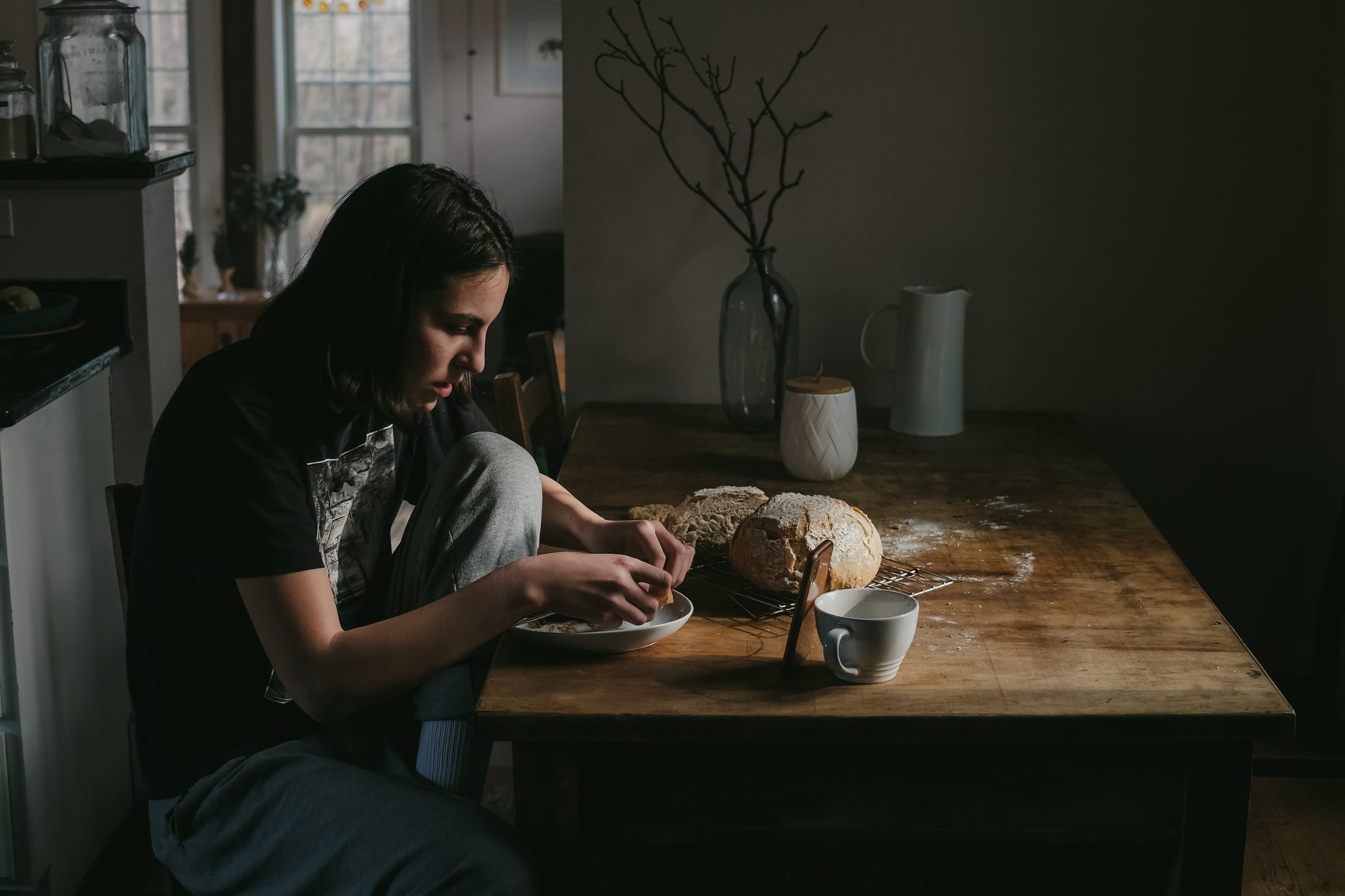
If this is you
You are always the last one at the table. You tear bread into small pieces, chew everything for a long time and keep a glass of water close. You have done it for so long that it feels normal.
The short answer
- Many people with EoE change the way they eat to get food down, often without noticing.
- These habits hide the problem and can delay the diagnosis for years, while the esophagus slowly narrows.
- If several of the habits below are yours, tell your doctor about them and ask about EoE.
What are the habits?
Doctors who treat EoE ask about six of them. The first letters spell the word IMPACT.
You may not think of it as a swallowing problem. You think of it as the way you eat.
Why do the habits matter?
The habits work. Food goes down, so you have fewer bad moments, and nobody looks for a cause. Meanwhile the inflammation continues.
In a Swiss study of 200 people with EoE, half had waited six years or longer for the diagnosis. Narrowing of the esophagus was found in about 1 in 6 people diagnosed within two years. It was found in about 7 in 10 of those who had waited more than twenty years.
What does this look like in a child?
Children rarely say that food is sticking. Refusing food, taking a long time to finish a meal and bringing food back up can be signs of the same hidden swallowing problem.
What should I do?
Tell your doctor about the habits themselves. If you are asked, “Do you have trouble swallowing?” you may honestly answer no, since you have found ways around it. Describe how you eat instead. The medical word for trouble swallowing is dysphagia.
EoE is diagnosed with an endoscopy, a short camera test in which small samples are taken from the lining of the esophagus.
Don’t wait on this
If food is stuck and will not pass, or you cannot swallow your own saliva, go to an emergency department.
Take these to your next appointment
- I have changed the way I eat to get food down. Could this be EoE?
- Should I have an endoscopy with samples taken from the esophagus?
- If my esophagus has narrowed, what can be done about it?
SourcesThe 2025 US guideline on diagnosing and treating EoE
Dellon ES, et al. ACG Clinical Guideline: Diagnosis and Management of Eosinophilic Esophagitis. Am J Gastroenterol. 2025.Review: the six eating habits doctors ask about in EoE
Hirano I, Furuta GT. Approaches and Challenges to Management of Pediatric and Adult Patients With Eosinophilic Esophagitis. Gastroenterology. 2020.Study: the longer EoE goes undiagnosed, the more often the esophagus narrows
Schoepfer AM, et al. Delay in diagnosis of eosinophilic esophagitis increases risk for stricture formation in a time-dependent manner. Gastroenterology. 2013.